Caring for an aging parent can feel like you’re juggling everything at once—meals, medications, emotions, and finances. If this sounds familiar, you’re not alone. The latest multigenerational living statistics reveal a steady rise in family caregiving as more households move in together to support aging relatives.
In this article, we’ll explore how many Americans are living with elderly loved ones, why this arrangement is becoming more common, and what it means for caregivers like you. With insights from Exceptional Care, you can get the support and resources you need to provide the best care for your elderly family member.
If you’re feeling burned out from your caregiving duties, Exceptional Care offers compassionate respite care to keep your loved ones safe while you rest and recharge. Contact us today to find out how we can provide the relief you deserve.
How many Americans live in multigenerational households?
About 1 in 5 Americans—or nearly 60 million people—currently live in multigenerational households. Many families choose this living arrangement to care for elderly parents at home, avoid nursing home placement, and share expenses during economic uncertainty.
What are the top reasons families choose multigenerational living arrangements?
Caregiving and economic necessity are two of the top reasons families live together across generations. Around 1 in 4 adults living in multigenerational homes either provide care for a loved one or require care themselves.
How many adults are involved in caregiving?
As of 2025, an estimated 53 million adults in the U.S. are providing unpaid care to aging parents, spouses, or extended family. This reflects a sharp increase in caregiver roles within multigenerational homes, where families band together to meet their loved ones’ health and emotional needs.
What percentage of family caregivers provide long-term care?
Roughly 80% of family caregivers provide long-term care, offering ongoing support for chronic conditions, doctor visits, and daily routines. For caregivers in multigenerational households, this often becomes a full-time role that shapes every aspect of family life.
How common is it for adults to live in multigenerational households due to financial stress?
Financial hardship is one of the biggest reasons families move in together. An estimated 60 million Americans live in multigenerational homes to lower costs by sharing mortgages, utilities, and caregiving duties.
What percentage of Hispanic adults live in multigenerational settings?
Approximately 26% of Hispanic adults live in multigenerational households. This reflects deep-rooted cultural values emphasizing familial support, elder care, and shared responsibility in times of need.
How many multigenerational families have caregiver duties?
More than 11 million caregivers in the U.S. reside in multigenerational homes, juggling responsibilities like meal prep, medical supervision, and emotional support while living with parents, children, or extended relatives.
Are caregivers balancing employment and caregiving responsibilities?
Yes—over 60% of caregivers work full- or part-time jobs in addition to their caregiving roles. Nearly 1 in 3 support both aging loved ones and children.
What percentage of caregivers face financial burdens?
About 67% of family caregivers report heightened financial stress due to caregiving. Many reduce work hours or leave jobs entirely to care for a loved one, while also covering out-of-pocket costs like medications, supplies, or home modifications.
How many caregivers are responsible for both older adults and children?
Roughly one-third of caregivers are part of the “sandwich generation,” supporting both elderly parents and young children. This dual responsibility is increasingly common in multigenerational living arrangements, contributing to widespread caregiver exhaustion.
What does caregiving look like for multigenerational caregivers?
For multigenerational caregivers, days often begin with school drop-offs and end with managing medications or assisting elderly parents. On average, they spend over an hour per day providing direct care on top of managing a household and full-time work.
What percentage of caregivers have difficulty balancing work and caregiving?
Nearly 70% of caregivers struggle to keep up with both professional and caregiving demands. Between coordinating medical appointments, preparing meals, and providing personal care, caregiver responsibilities can lead to stress, fatigue, and burnout.
What is the experience of adults living in multigenerational households?
While multigenerational living comes with challenges, 56% of adults report the experience as at least somewhat positive, and 30% say it’s very positive. Many family caregivers find that sharing a home fosters deeper connections, provides emotional support, and strengthens family bonds.
Take a Much-Needed Break with Respite Care from Exceptional Care
If you’re feeling overwhelmed by your family caregiving duties, Exceptional Care is here for you. Our trained caregivers provide respite care to keep your loved one safe and comfortable while you take time to rest and recharge.
Contact us today to learn how we can support you and your family with compassionate in-home care.
Sources
D’Vera Cohn. “The demographics of multigenerational households.” Pew Research Center. March 24, 2022. https://www.pewresearch.org/social-trends/2022/03/24/the-demographics-of-multigenerational-households/
Taylor Shuman. “Family Caregiver Annual Report and Statistics.” SeniorLiving.Org. February 14, 2025. https://www.seniorliving.org/research/family-caregiver-report-statistics/
Jennifer L. Wolff. “Number of Family Caregivers Supporting Older Adults Increased Nearly One-Third Between 2011 and 2022.” February 4, 2025. https://publichealth.jhu.edu/2025/number-of-family-caregivers-supporting-older-adults-increased-nearly-one-third-between-2011-and-2022
D’Vera Cohn. “Financial Issues Top the List of Reasons U.S. Adults Live in Multigenerational Homes.” Pew Research Center. March 24, 2022. https://www.pewresearch.org/social-trends/2022/03/24/financial-issues-top-the-list-of-reasons-u-s-adults-live-in-multigenerational-homes/
Bruce Horovitz. “New AARP Report Finds Family Caregivers Provide $600 Billion in Unpaid Care Across the U.S.” AARP. March 8, 2023. https://www.aarp.org/caregiving/financial-legal/info-2023/unpaid-caregivers-provide-billions-in-care.html
AARP. “New U.S. Workforce Report: Nearly 70% of Family Caregivers Report Difficulty Balancing Career and Caregiving Responsibilities, Spurring Long-Term Impacts to U.S. Economy.” May 16, 2024. https://press.aarp.org/2024-5-16-US-Workforce-Report-70-Caregivers-Difficulty-Balancing-Career-Caregiving-Responsibilities
Gretchen Livingston. “More than one-in-ten U.S. parents are also caring for an adult.” November 29, 2018. https://www.pewresearch.org/short-reads/2018/11/29/more-than-one-in-ten-u-s-parents-are-also-caring-for-an-adult/



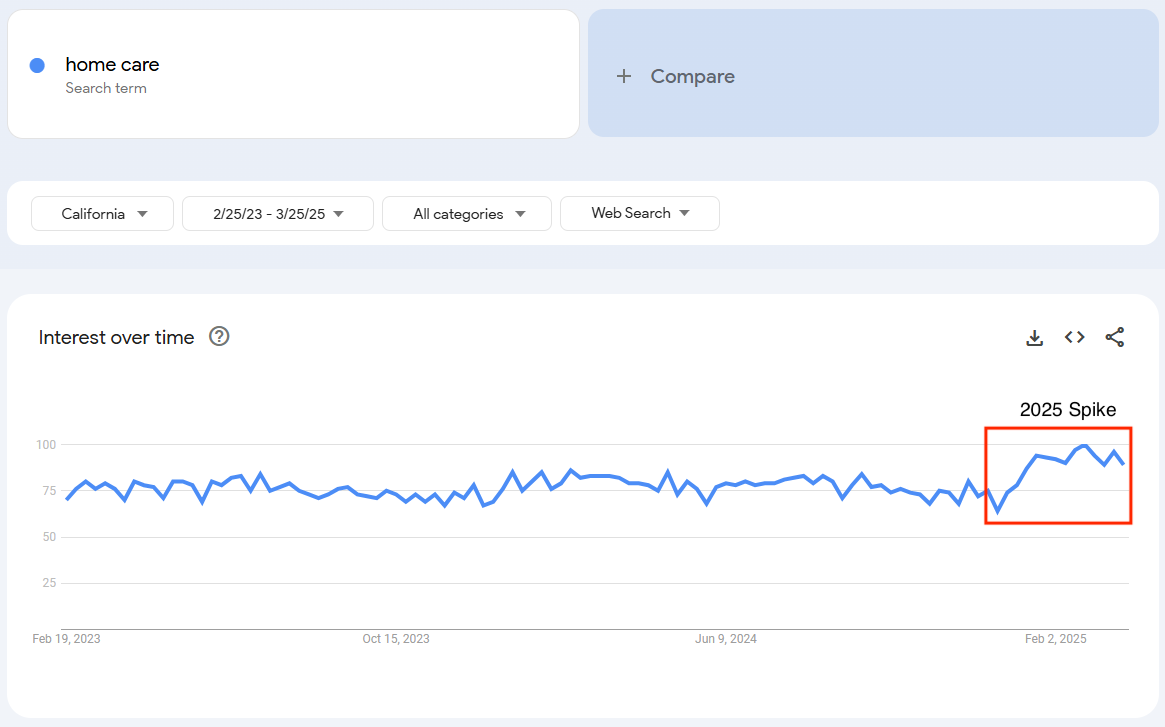
 Nearly one in four California residents will be over the age of 65 by 2040, signaling the increasing demand for senior care throughout the state.
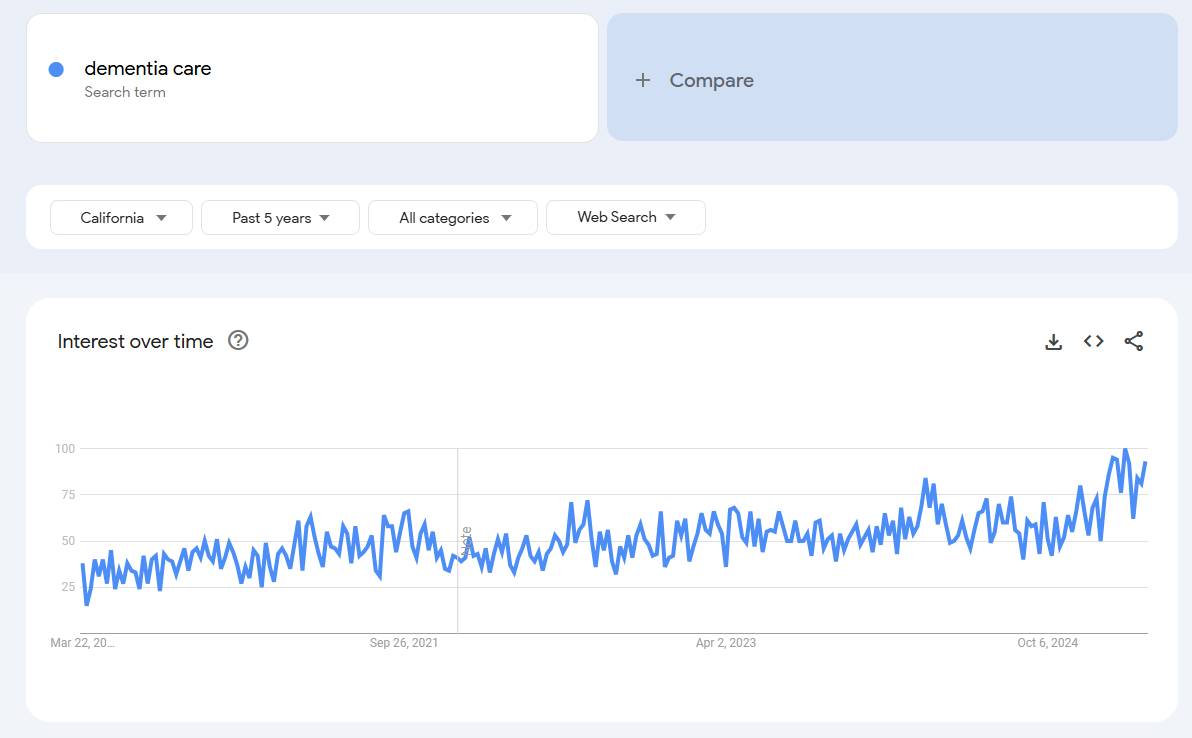
 This cultural shift toward early detection is a key driver behind the 145% increase in dementia care searches across California.
 As families struggle to meet growing care demands, they’re increasingly turning to Google for answers and solutions.